

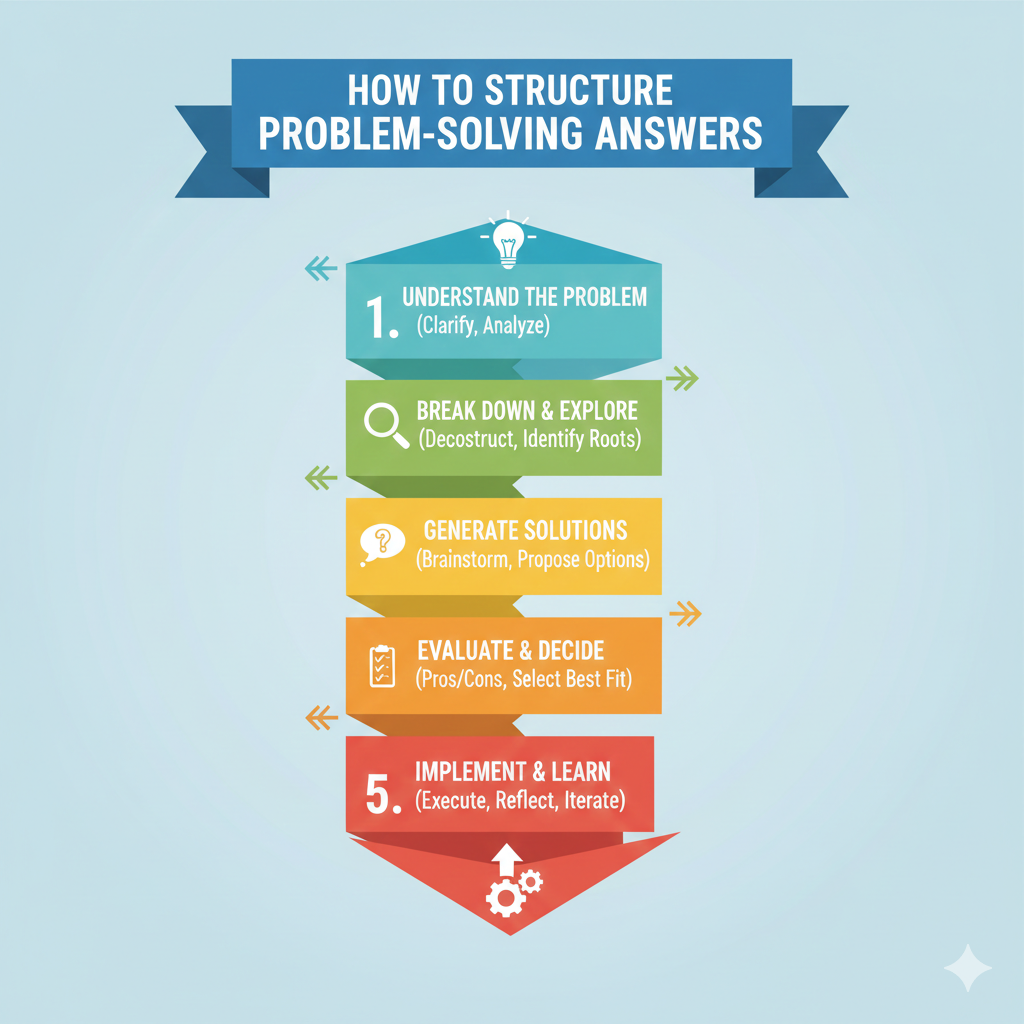
Introduction
Strong problem-solving skills matter in almost every role. However, knowing how to solve problems is not enough. You must also explain your thinking clearly. Many capable professionals fail interviews or miss influence at work simply because their answers feel scattered. That is why learning how to structure problem-solving answers is a critical career skill.
Well-structured answers show clarity, confidence, and decision-making ability. They help interviewers and managers follow your thinking without effort. More importantly, they signal that you can handle real-world complexity calmly.
This blog explains how to structure problem-solving answers in a simple, practical way.
Why structure matters more than the solution itself
In many situations, there is no single correct solution. Interviewers and leaders focus on how you think, not just what you decide.
A clear structure shows logical reasoning. It proves that you can break down complexity and prioritize effectively. Even average solutions sound strong when explained well.
On the other hand, unstructured answers feel confusing, even if the idea is good. That confusion reduces trust quickly.
What interviewers and managers listen for
Decision-makers listen for patterns. They want to hear clarity, sequence, and reasoning. Rambling answers create doubt about your thinking.
They look for three things. First, do you understand the problem? Second, can you analyze it logically? Third, can you move toward a decision?
Structured answers help you hit all three without sounding rehearsed.
Start by clearly defining the problem
Every strong answer begins with clarity. Before jumping into solutions, state the problem in simple terms.
This shows that you understand the situation. It also aligns you with the listener’s perspective. Many candidates skip this step and lose control of the answer early.
Defining the problem sets direction. It also prevents assumptions from confusing your response.
Break the problem into manageable parts
Once the problem is clear, show how you break it down. Complex problems become easier when divided into smaller components.
You might separate causes, constraints, or stakeholders. The goal is to show organized thinking, not technical depth.
This step proves you can handle complexity without panic. It is a key part of how to structure problem-solving answers effectively.
Explain your approach before the solution
Before sharing the final answer, explain how you plan to approach the problem. This step is often overlooked but very powerful.
It shows intention and method. Interviewers appreciate knowing why you chose a certain direction.
This also gives you flexibility. Even if the solution is imperfect, the approach can still impress.
Walk through your reasoning step by step
Now move through your reasoning in a logical flow. Keep sentences short and focused. Avoid jumping between ideas.
Each step should build on the previous one. This creates momentum and keeps the listener engaged.
If trade-offs exist, acknowledge them briefly. Balanced thinking builds credibility.
Show decision-making, not endless analysis
Many professionals overanalyze. They explain every possibility and never land on a decision. This weakens confidence.
Strong problem-solving answers move toward action. After analysis, clearly state what you would do and why.
Decision-making shows ownership. Employers value professionals who can act under uncertainty.
Highlight results or expected outcomes
Whenever possible, connect your solution to outcomes. Explain what success would look like after implementation.
This shifts the answer from theory to impact. It shows business awareness and responsibility.
Even in hypothetical scenarios, outcomes strengthen your response.
Adapt structure to different situations
The same structure works in interviews, meetings, and presentations. However, depth may vary.
In interviews, keep answers concise and focused. In workplace discussions, add more context if needed.
The core remains the same. Clarity, breakdown, reasoning, and decision.
This adaptability makes how to structure problem-solving answers a transferable skill.
Common mistakes to avoid
One common mistake is jumping straight to the solution. This skips your thinking process.
Another mistake is using too much jargon. Complexity does not equal intelligence. Clarity does.
Some professionals also speak defensively, over-explaining mistakes. Calm, neutral tone works better.
Avoid these errors to keep your answers strong and confident.
Practicing structured problem-solving answers
Structure improves with practice. Start by reviewing past problems you handled.
Rewrite your answers using a clear flow. Practice explaining them aloud in two to three minutes.
Over time, structured thinking becomes natural. You no longer need to memorize formats.
This habit improves both interviews and daily communication.
How structured answers improve career growth
Professionals who communicate clearly gain trust faster. Leaders rely on them for decisions and problem resolution.
Structured problem-solving answers increase influence. People listen more closely when ideas flow logically.
This skill also boosts confidence. You know how to respond even under pressure.
That confidence compounds over time.
Conclusion
Problem-solving is not just about finding answers. It is about explaining them clearly. That is how to structure problem-solving answers in a way that builds trust and credibility.
When you define the problem, break it down, explain your approach, and move toward a decision, your answers stand out. Structure turns thinking into impact.
Use the best job tool to find roles where strong problem-solving and clear communication are valued and rewarded.
Find Your Dream Job Today – Explore Endless Career Opportunities and Secure Your Next Role with Best Job Tool.






Comments
Be the first to leave a comment.