

Introduction
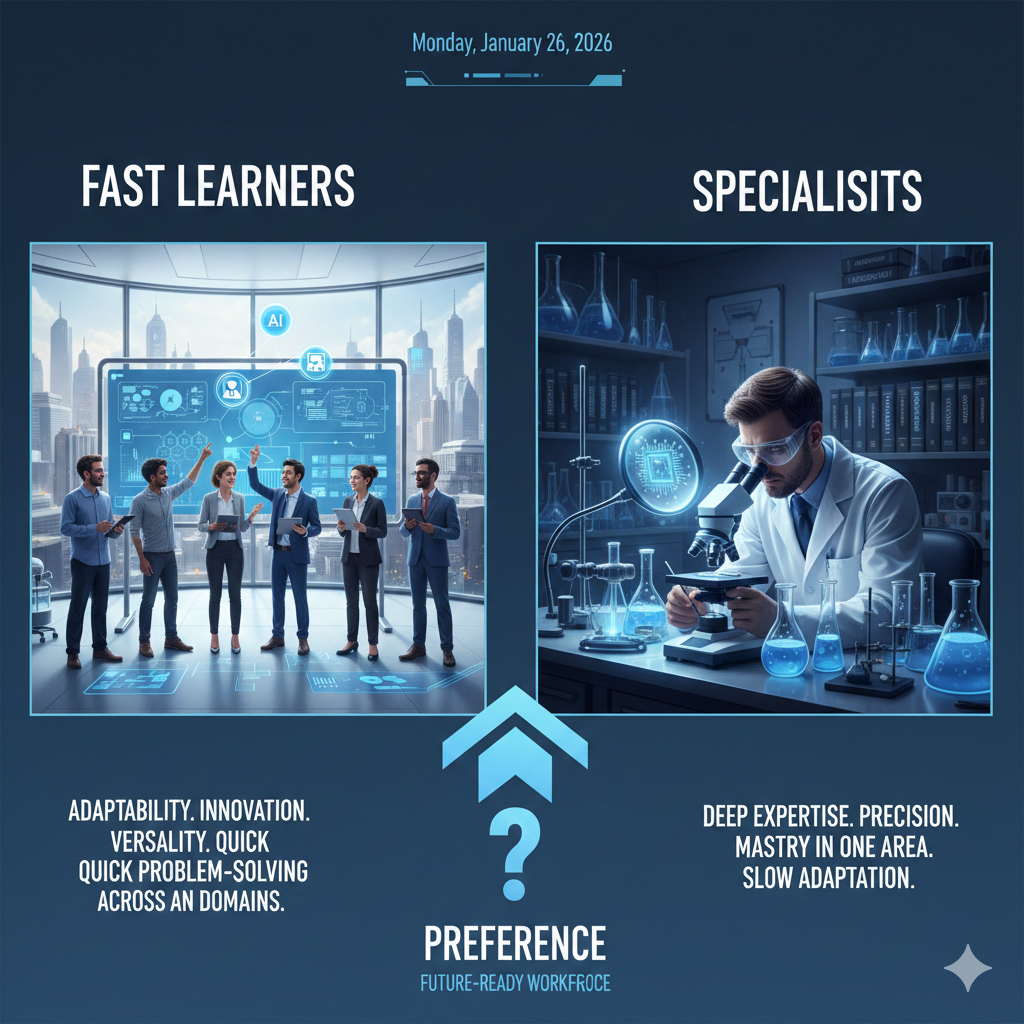
Hiring trends have changed. Many companies still value specialists, but they increasingly prioritize fast learners. This shift is not random. It reflects how quickly tools, markets, and job requirements evolve. Teams want people who can adapt, learn, and deliver even when the situation changes.
Understanding why fast learners are preferred over specialists helps job seekers position themselves better. It also helps professionals grow faster inside competitive workplaces. Fast learning is no longer a bonus skill. It has become a career advantage.
Modern roles change faster than job titles
Most roles today are not fixed. Responsibilities expand as companies grow. Tools update regularly. New priorities appear without warning.
A specialist may be excellent in one area. However, if the role shifts, they may struggle to keep up. On the other hand, a fast learner can adjust quickly. They can pick up new workflows, new tools, and new expectations without slowing the team.
This is one reason why fast learners are preferred over specialists. Companies want stability during change. Adaptable employees provide that stability.
Fast learners reduce training time and team dependency
Every new hire requires onboarding. They need time, guidance, and support. This costs the company productivity.
Fast learners reduce this cost. They understand processes quickly. They ask better questions. They make fewer repeated mistakes. As a result, managers spend less time correcting and more time scaling work.
Teams also become more efficient. Senior members can focus on high-impact tasks instead of constant support.
This makes fast learners valuable, especially in fast-moving teams.
Business problems need flexible thinking, not fixed expertise
Many workplace challenges are not textbook problems. They are messy, changing, and uncertain.
A specialist may solve a specific type of problem very well. But when the problem changes shape, fixed expertise may not be enough. Fast learners handle uncertainty better. They learn what is needed, then apply it immediately.
This is why fast learners are preferred over specialists in startups, growth teams, and cross-functional roles. These environments reward flexibility and learning speed.
Fast learners perform better in cross-functional work
Most companies now work across teams. Marketing works with sales. HR works with operations. Product works with engineering. These collaborations require understanding beyond one skill set.
Fast learners adapt to different teams and communication styles. They learn the basics of other functions quickly. They understand priorities without needing long explanations.
This reduces friction and improves delivery.
Specialists may still be strong, but if they cannot work outside their lane, they may slow down collaboration. That is a risk companies want to avoid.
Fast learners keep up with tools and automation
Technology is changing job requirements rapidly. AI tools, automation, dashboards, and platforms are now part of daily work.
A specialist who refuses to learn new tools can become outdated. Meanwhile, a fast learner stays current. They upgrade skills continuously and remain useful across changing systems.
This matters because companies want future-ready employees. They want people who can grow with the business, not people who depend on old methods.
That is another reason why fast learners are preferred over specialists in many industries today.
Hiring managers value growth potential and long-term fit
Hiring is not only about today’s tasks. It is also about future needs. Managers often hire based on potential, not only experience.
Fast learners show growth potential. They prove they can handle new responsibilities. They also prove they can grow into leadership roles.
Specialists can be highly valuable, but their growth path may be narrower. Some specialists also prefer staying in one area, which is not always aligned with business expansion.
Managers often choose the candidate who can evolve with the team.
Specialists are still valuable, but only with adaptability
This does not mean specialists are not needed. Many roles require deep expertise. Security, finance, engineering, and compliance often depend on specialists.
However, the most successful specialists are also fast learners. They stay updated. They improve their methods. They expand their understanding beyond one narrow skill.
So the real preference is not against specialists. It is against rigid specialists. Companies want depth with flexibility.
When you combine expertise with learning speed, you become extremely valuable.
How to show fast learning in interviews and resumes
Fast learning is not a claim. It is something you prove through examples.
Show situations where you learned a new tool quickly. Mention how you handled new responsibilities without delay. Highlight projects where you adapted to change and still delivered results.
You can also show learning through certifications, portfolio work, and continuous improvement habits.
Keep your examples practical. Recruiters trust evidence more than statements.
When you show learning ability clearly, you stand out even in competitive roles.
Conclusion
Workplaces are changing quickly. That is why fast learners are preferred over specialists in many teams today. Fast learners reduce training time, adapt to new tools, handle uncertainty, and support cross-functional work. They also bring long-term value because they grow with the business.
Specialists still matter, but adaptability makes the difference. The most successful professionals combine strong skills with strong learning speed.
To explore roles that reward growth, adaptability, and future-ready skills, use the best job tool.
Find Your Dream Job Today – Explore Endless Career Opportunities and Secure Your Next Role with Best Job Tool.






Comments
Be the first to leave a comment.