

Introduction
Feedback plays a major role in professional growth. However, what many people overlook is timing. Feedback delivered too late often loses its value, even if it is accurate. This is exactly why feedback timing affects growth more than most professionals realize.
Growth depends on learning loops. When feedback arrives at the right moment, it shapes behavior quickly. When it comes too late, learning slows down or stops entirely. Understanding this difference helps individuals, managers, and teams grow more effectively.
What feedback timing really means
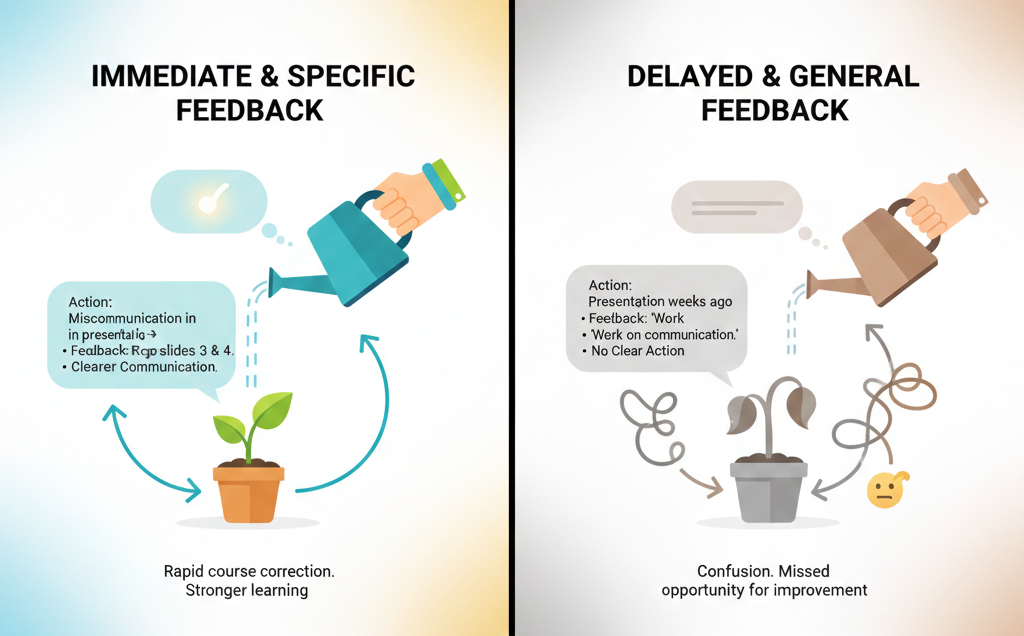
Feedback timing refers to when input is shared in relation to action. Immediate or near-term feedback connects directly to behavior. Delayed feedback feels disconnected and abstract.
When feedback is timely, people remember the context clearly. They can link advice to specific actions. This clarity makes improvement easier and faster.
Poor timing weakens this connection. Even good advice loses impact when memory fades.
Why delayed feedback slows learning
Learning works best with short feedback cycles. The longer the gap, the weaker the learning signal becomes.
Delayed feedback forces people to guess what went wrong. They may repeat mistakes unknowingly. This creates frustration instead of improvement.
Over time, delayed feedback discourages initiative. People stop experimenting because guidance feels unreliable.
This is a key reason why feedback timing affects growth outcomes significantly.
Immediate feedback builds faster skill correction
Immediate feedback allows quick adjustment. Small corrections happen before habits form.
For example, feedback given right after a presentation helps improve the next one instantly. Waiting weeks reduces relevance and urgency.
Fast feedback creates momentum. It turns learning into an active process instead of reflection alone.
Professionals who receive timely input improve faster with less effort.
The emotional impact of feedback timing
Timing affects emotional response as much as skill development. Feedback delivered too late can feel like criticism rather than support.
When feedback is timely, it feels helpful. The intention feels aligned with improvement, not judgment.
Late feedback often triggers defensiveness. People wonder why the issue was not addressed earlier.
This emotional shift explains why feedback timing affects growth and confidence simultaneously.
How feedback timing influences motivation
Motivation thrives on clarity. Timely feedback provides that clarity.
When people know what to improve immediately, effort feels purposeful. Progress becomes visible.
Delayed feedback creates uncertainty. People doubt whether their effort is moving in the right direction.
Over time, this uncertainty reduces engagement and willingness to take ownership.
Feedback timing and habit formation
Habits form through repetition and correction. Feedback timing determines whether habits improve or solidify mistakes.
Early feedback shapes behavior before patterns lock in. Late feedback tries to undo habits, which is harder.
This applies to technical skills, communication styles, and leadership behavior.
That is why feedback timing affects growth at a foundational level.
The role of managers in timing feedback correctly
Managers play a critical role in feedback timing. Waiting for formal reviews often delays learning unnecessarily.
Effective managers give feedback close to the moment of action. They keep it specific and constructive.
This approach builds trust. Employees see feedback as guidance, not evaluation.
Timely feedback also reduces the need for difficult corrective conversations later.
Peer feedback and its timing advantages
Peer feedback often arrives faster than manager feedback. This makes it powerful.
Teams that share feedback in real time adapt quickly. Collaboration improves naturally.
When peer feedback is encouraged early, learning becomes collective instead of hierarchical.
This dynamic reinforces why feedback timing affects growth at the team level.
When delayed feedback still has value
Delayed feedback is not always useless. It helps with reflection and long-term patterns.
However, it should complement timely feedback, not replace it. Reflection works best after immediate correction has occurred.
Used together, both types strengthen learning. Timing determines which one leads.
Understanding this balance improves development strategies.
Common feedback timing mistakes
One common mistake is saving feedback for performance reviews. This turns learning into evaluation.
Another mistake is waiting for “the right moment” too long. Discomfort avoidance often delays growth.
Some professionals also give feedback only when things go wrong. This skews learning negatively.
Avoiding these mistakes improves both performance and morale.
How individuals can ask for better-timed feedback
Professionals do not need to wait passively. Asking for feedback early improves timing.
Request input after meetings, presentations, or projects. This signals growth mindset.
When you control timing, feedback becomes more useful. You turn guidance into action quickly.
This proactive approach accelerates development.
How organizations benefit from timely feedback cultures
Organizations that value timely feedback grow faster. Learning cycles shorten across teams.
Mistakes get corrected early. Innovation feels safer because guidance is continuous.
Such cultures outperform those relying on delayed evaluations.
This is why feedback timing affects growth at both individual and organizational levels.
Conclusion
Feedback alone does not drive growth. Timing determines whether feedback turns into learning or frustration. That is why feedback timing affects growth more than feedback volume or intensity.
When feedback arrives close to action, improvement accelerates. Confidence grows, habits form correctly, and motivation stays high.
Use the best job tool to find workplaces that value continuous feedback, growth-oriented cultures, and real development opportunities.
Find Your Dream Job Today – Explore Endless Career Opportunities and Secure Your Next Role with Best Job Tool.






Comments
Be the first to leave a comment.