

Introduction
The job market today looks very different from a few years ago. Roles evolve quickly, tools change often, and expectations continue to rise. Because of this shift, relying on a single skill is no longer enough. Employers now want professionals who can contribute in multiple ways. This is why skill stacking for job opportunities has become a critical career strategy.
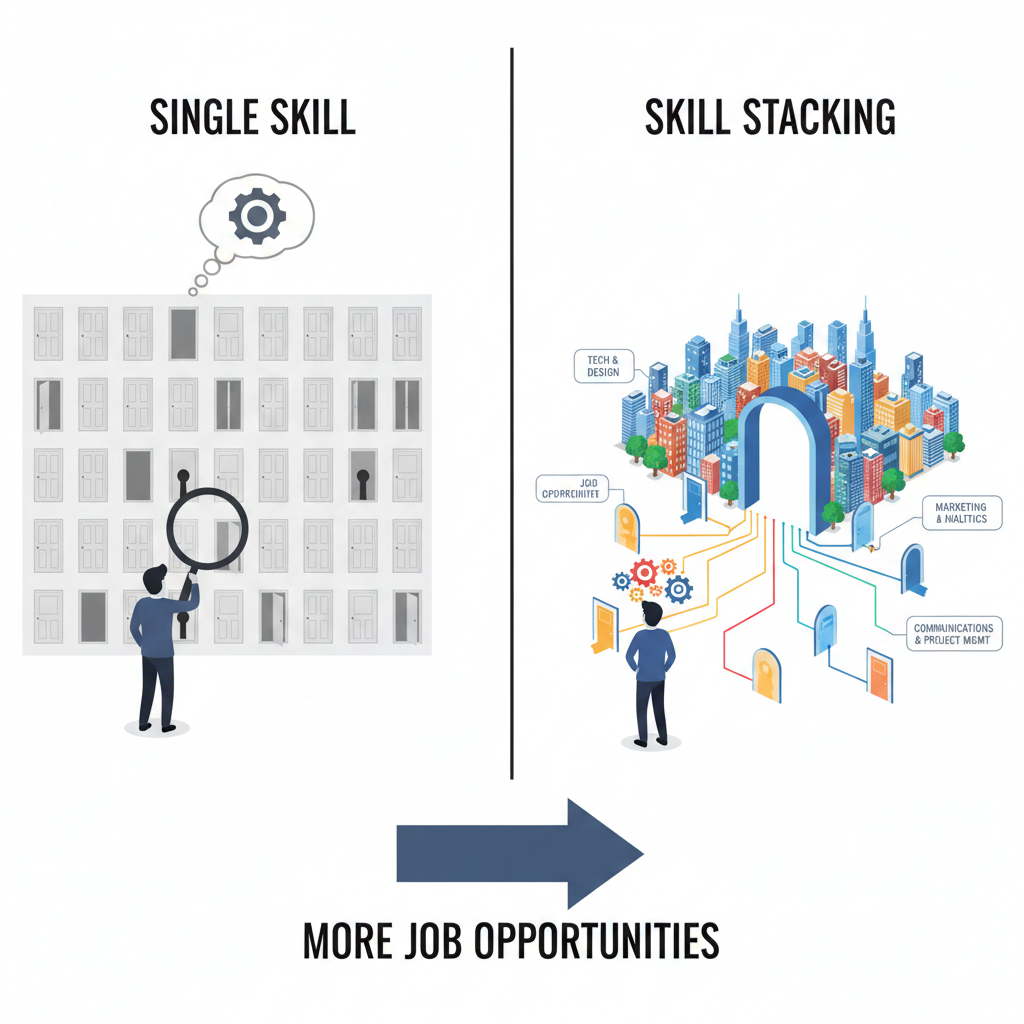
Skill stacking means combining two or more complementary skills to create a stronger professional profile. Instead of being limited to one function, you become useful across tasks and teams. As a result, employers see you as adaptable, capable, and future-ready. In competitive hiring environments, this advantage matters greatly.
How the job market rewards versatility
The modern job market rewards professionals who can wear multiple hats. Companies operate with leaner teams and tighter budgets. Therefore, they prefer candidates who can handle more than one responsibility.
Versatile employees reduce dependency on multiple hires. They also help teams move faster. Because of this, job descriptions increasingly list hybrid skill requirements.
Skill stacking aligns perfectly with this demand. When you combine related skills, your profile matches a wider range of roles. Consequently, you qualify for more opportunities across industries and functions.
Why skill stacking for job opportunities attracts recruiters
Recruiters search for candidates who bring immediate value. When they see a stacked skill set, they see efficiency and flexibility. This impression makes your profile more attractive.
Skill stacking also improves resume and profile visibility. Applicant tracking systems scan for multiple relevant keywords. A stacked skill profile naturally performs better in these systems.
Moreover, recruiters feel confident recommending such candidates. They know these professionals can grow into changing roles. For this reason, skill stacking for job opportunities significantly improves recruiter interest.
Skill stacking improves employability across industries
Industries no longer operate in isolation. Technology influences marketing. Data shapes decision-making. Communication supports almost every role.
Professionals with stacked skills can move across industries more easily. They are not limited by strict role definitions. Instead, they adapt their skills to new contexts.
For example, a professional with analytical and communication skills fits roles in marketing, operations, and strategy. This flexibility increases employability. It also protects careers during industry slowdowns.
Employers value problem solvers over narrow specialists
Specialists focus deeply on one area. While that depth is useful, it can limit flexibility. Employers now prefer professionals who solve problems holistically.
Skill stacking develops this mindset naturally. When you combine skills, you learn to see connections. You understand how decisions affect different areas.
This ability improves execution and judgment. Employers benefit from employees who think beyond their job title. That is why problem solvers often outperform narrow specialists in modern workplaces.
Examples of effective skill stacks employers notice
Employers consistently notice certain skill combinations. These stacks show balance between execution and understanding.
Strong skill stacks often include:
- Technical skills combined with communication abilities
- Data analysis paired with business or domain knowledge
- Content creation supported by SEO and performance tracking
- Project coordination combined with stakeholder management
Each stack increases role readiness. Together, they signal maturity and reliability. Employers trust candidates who demonstrate these combinations.
Skill stacking increases career resilience
Job roles change rapidly due to automation and technology. Skills that are in demand today may decline tomorrow. This uncertainty makes career resilience essential.
Skill stacking provides protection against these shifts. When one skill loses relevance, others continue to create value. This balance reduces dependency on a single role.
Employers also value this resilience. They prefer candidates who can pivot without starting over. Therefore, skill stacking for job opportunities supports long-term career stability.
How skill stacking supports faster career growth
Career growth depends on how much value you create. Skill stacking increases that value steadily.
Employees with multiple skills often take ownership of complex tasks. They contribute beyond expectations. This visibility accelerates recognition and trust.
Managers delegate more responsibility to such professionals. Over time, promotions and growth follow naturally. Skill stacking becomes a catalyst for faster career progression.
Practical ways to start skill stacking today
Skill stacking does not require drastic career changes. It begins with awareness and consistent effort.
You can start by identifying skills adjacent to your current role. Learning one complementary skill at a time works best.
You can also volunteer for cross-functional projects. Real-world practice strengthens understanding faster than theory alone. Over time, these small steps compound into a strong skill stack.
Consistency matters more than speed. Even gradual progress creates lasting impact.
Why skill stacking for job opportunities defines the future of work
The future of work demands adaptability. Automation, AI, and digital transformation will continue to reshape roles.
Skill stacking prepares professionals for this future. It encourages continuous learning and flexibility. Employers value this mindset deeply.
In conclusion, skill stacking for job opportunities is no longer optional. It increases employability, resilience, and career growth. Professionals who stack skills remain relevant, competitive, and confident in changing markets.
To turn your skill stack into real opportunities, connect with the right employers. Use the best job tool to explore roles that value versatility and growth.
Find Your Dream Job Today – Explore Endless Career Opportunities and Secure Your Next Role with Best Job Tool.






Comments
Be the first to leave a comment.